What I notice with my students is that the challenge is often the amount of information and the many possibilities out there - and that's completely understandable.
That's why having a plan, together with logging your trades, is so important. Partly because I can follow along closely and give direction, this creates a feedback loop that can improve your process quickly.
I'm guiding you toward keeping things exceptionally clear and simple. So my advice is to focus on recognizing one pattern, and then build a plan/strategy around it in the form of a very clear (objective) confirmation checklist of no more than a few briefly described points. See below.
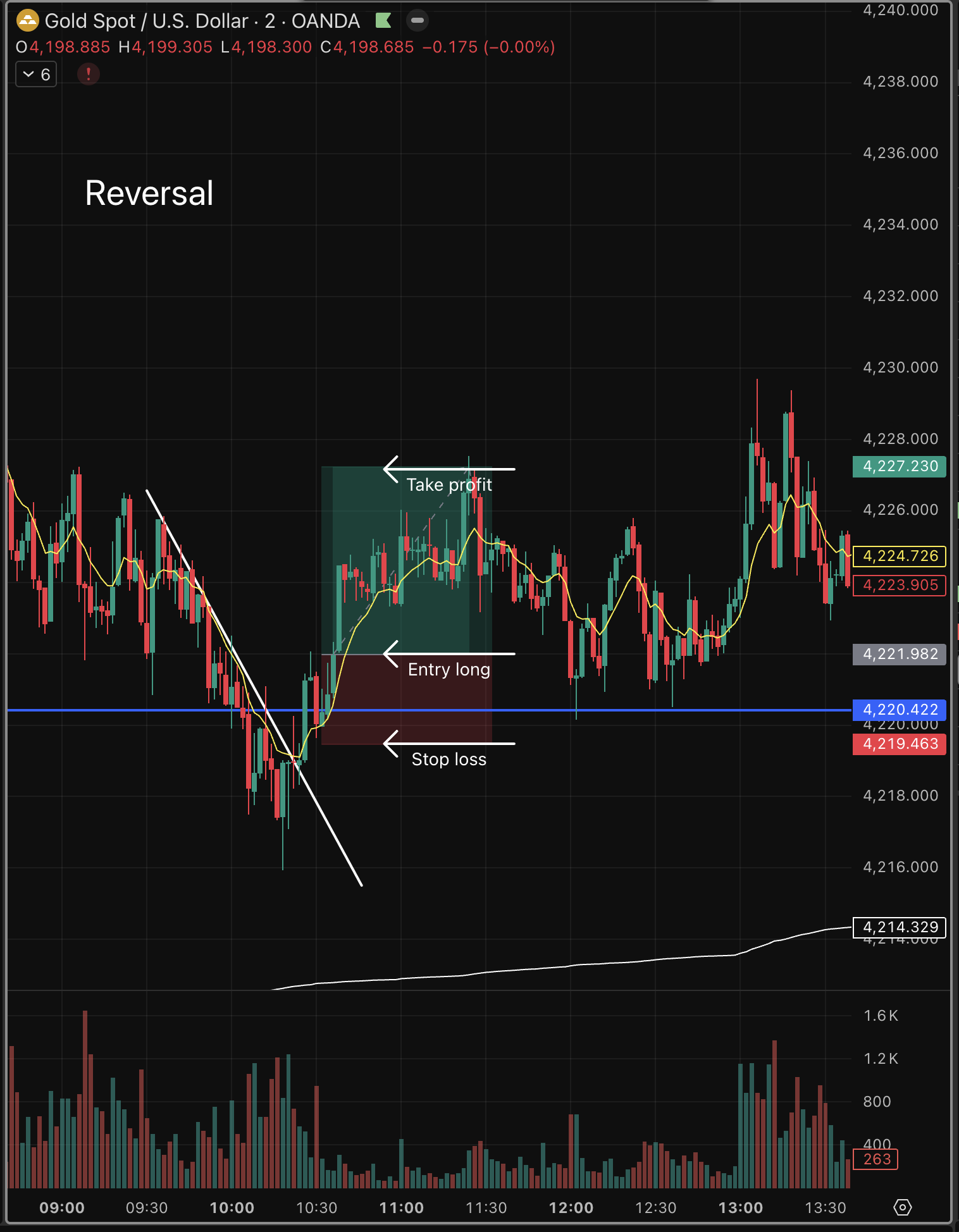
Reversal long (2-minute timeframe):
- Price reaches a key level
- Price breaks the trend
- Shows a reversal pattern after the trend break (pullback into the 9EMA on the 5-minute chart, see below) and breaks above previous highs
- No 9EMA extension on the 5-minute chart: price action is supported by the 9EMA on the 5-minute chart (example)
- ATR preferably at 80–120%
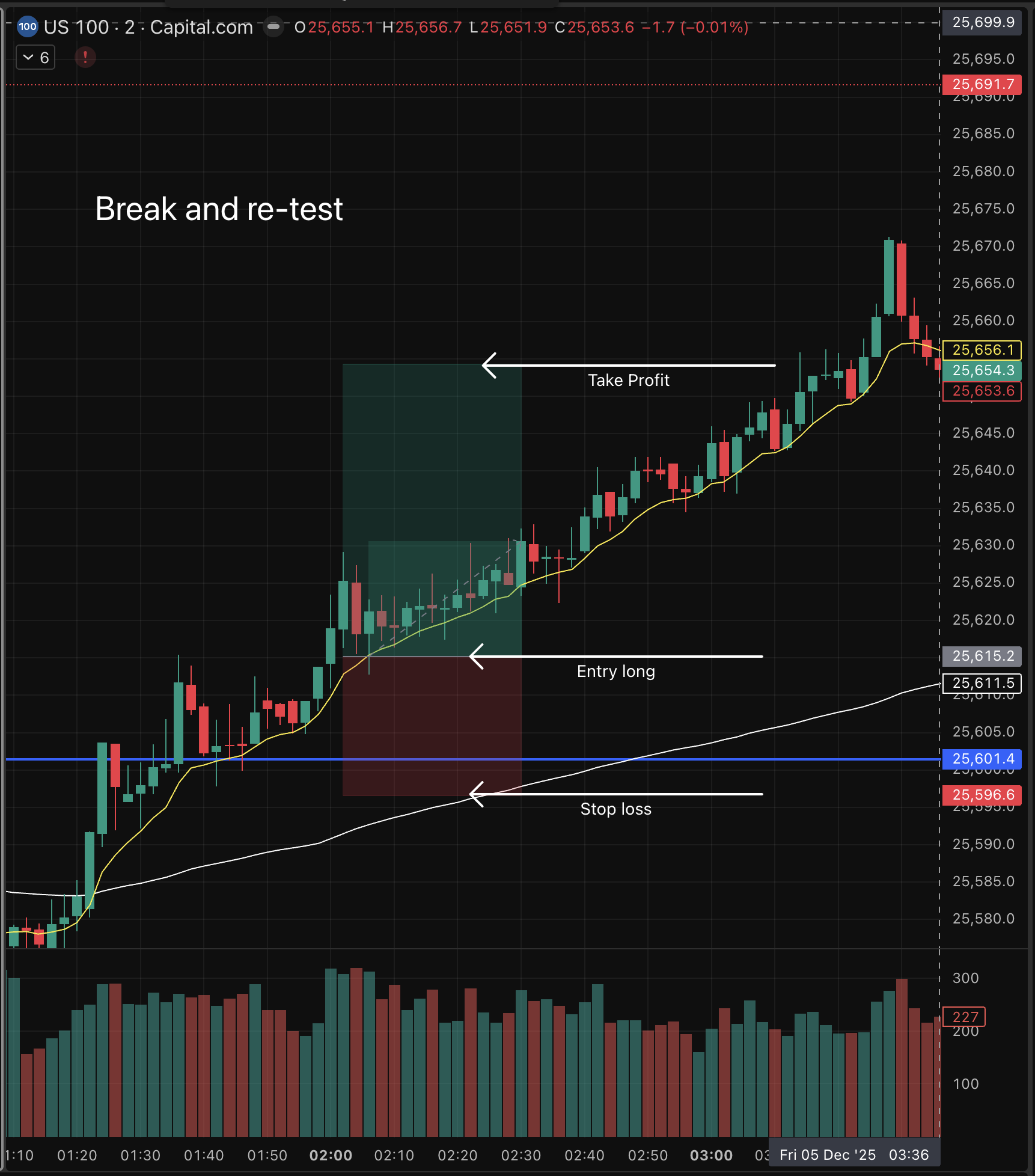
Break and retest long (2-minute timeframe):
- Breaks through a key level
- Pullback / consolidation (retest of the level)
- Breaks above prior highs to the left
- Remaining room within the ATR
- No 9EMA extension on the 5-minute chart: price action is supported by the 9EMA on the 5-minute chart (example)
General checklist (for any plan/strategy)
- Supported by VWAP or 2R room toward VWAP
- Room for a 2R reward-to-risk target toward resistance / 50% retracement level
- Stop loss between 10% and 20% of ATR
- Stop loss below the last low on the 2-minute chart
Make this framework your own and decide for yourself which points matter most. It's not set in stone. It's not a 100% requirement.
For both strategies, ideally you trade with the trend on the daily chart. So how do you read the trend?
- If we're trading above the 9EMA on the daily chart, we look at longs
- If we're trading below the 9EMA on the daily chart, we look at shorts
Ideally you also get confirmation from the VWAP here: if we're trading above the VWAP we look at longs. If we're trading below the VWAP we look at shorts. Once you're a bit further along you can also trade counter-trend (against the trend), for example by trading back (short) toward the VWAP to mean-revert from that extension on a bullish (long) daily chart.
For the sake of focus and clarity I'm describing the long side here. Short is of course possible too, just in the other direction.
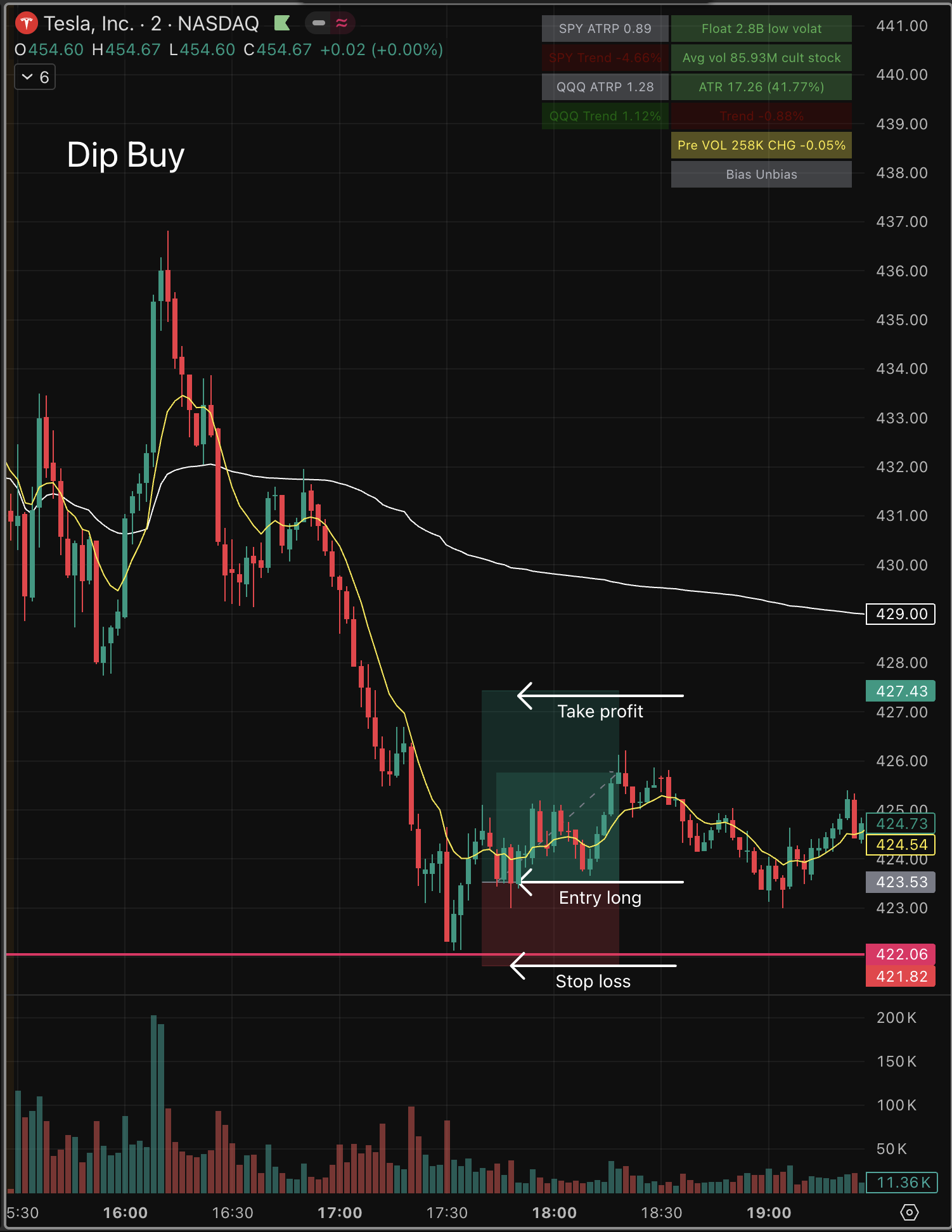
As an extra I've also attached a Reversal Dip on TSLA. Here you enter after a sharp drop once the 2-minute buyers’ candle breaks, and you do NOT wait for a reversal pattern. That's a somewhat more challenging reversal. There are also plenty of other strategies possible once you get further along in this process - but for now: keep it simple.
Also another example of a Reversal Dip on XOM (Link removed due to copyright) with a checklist of confirmation points as a useful example.
Trust the process. It takes time, and once the puzzle pieces start falling into place, it compounds: your understanding grows and becomes progressively stronger.
For perspective, I needed a few months to really get a grip on this. So needing half a year of training is perfectly normal. It's about experiencing calm and enjoyment in the process, and that goes hand in hand with having a clear plan, organized logging, and reflecting with me.
Here are two Mastery Training recordings on the reversal and the break and retest respectively:
https://daytradingmasterclass.wistia.com/medias/yz9e4pd2me (Link removed due to copyright)
https://daytradingmasterclass.wistia.com/medias/hus0ac6utl (Link removed due to copyright)
More recently Arjan recorded a 3-part series (from 09-04-2025) on how to trade the ideal reversal. See Mastery recordings (Link removed due to copyright).
Attachments:
- Reversal in gold
- Break and retest on the US100
- EXTRA: Dip-buy TSLA